
Catawba Supervision Status Differences
Three labels often appear together in conversation, yet North Carolina law treats them separately. Probation is a community sentence imposed by a court. A Catawba County defendant can receive probation without ever entering a state prison. Post-release supervision, often shortened to PRS, is the supervised part of a covered Structured Sentencing felony term after prison. Parole is discretionary conditional release before a sentence expires under parole law. It mainly applies to eligible offenses committed before Structured Sentencing took effect, with limited exceptions. The North Carolina parole process explains that dividing line.
A fourth label matters: discharge. Discharge means the supervision obligation has ended. A record showing release to PRS does not mean discharge, because conditions remain and violations may lead to revocation. Likewise, release from the Catawba County Detention Facility on bond does not itself create parole, probation, or PRS. The court judgment and the North Carolina Department of Adult Correction record control.
| Status | How it begins | Best confirmation |
|---|---|---|
| Probation | A court orders a community sentence or condition. | DAC Offender Public Information and the court judgment. |
| Post-release supervision | A covered prison sentence reaches its statutory supervised portion. | DAC status, release history, and Community Supervision. |
| Parole | The Commission grants conditional release in an eligible parole-law case. | DAC record and Commission publication or contact. |
| Discharge | The supervision term lawfully ends. | DAC termination status or an official discharge record. |
Verify Catawba Post-Release Supervision
The DAC Criminal Offender Searches gateway is the official starting point. Its Offender Public Information tool covers state prisoners, probationers, and parolees. It also links separate absconder and release searches. This is not the county jail database. A person who posted bond in Newton and never received a DAC sentence may have no state supervision record from that booking.
- Open the gateway and select Offender Public Information. Use the DAC offender number when known, since a name alone can match more than one person.
- Otherwise search the surname and given name. Compare the offender number, identity details, conviction, admission, and sentence information before choosing a result.
- Read the exact current status. “Active Probationer/Parolee” identifies an active state supervision record, but the detail should show which type applies.
- Review incarceration and community-supervision history. A prior release entry records a past event and does not by itself prove that supervision is still open.
- If the public entry is unclear, use the district directory or a DAC public-record request. Ask only for public status and termination facts.
Catawba Probation District 25
Catawba County is part of DAC Community Supervision Judicial District 25 with Burke and Caldwell counties. The district and local office directory listed the district office in Valdese when the research was completed. Office assignments and managers change, so the live directory and telephone numbers are safer than relying on a named officer. Reporting directions are individual conditions. They should come from the person’s paperwork or assigned officer, not from a general web page.
309 Colombo Street SW, Suite 104
Valdese, NC 28690
828-432-2853 or 828-437-7452
Fax: 828-432-2841
The office can route a lawful question about district supervision, but person-level details may be limited. Begin with OPI and have the DAC offender number ready. For a court-ordered probation term, the Catawba County judgment also states the sentence and conditions. The Catawba court contact directory routes requests for filed court records.
Catawba Absconder and Warrant Checks
An absconder is a supervised person whom DAC alleges has failed to remain available or comply with supervision. The DAC gateway has a specific absconder search. That label is not a new conviction. It also does not prove the person is currently in the Catawba jail. A supervision violation may later lead to a warrant, arrest, or revocation hearing, but each event needs its own record.
Check the Catawba “Who’s in Jail” roster separately for present county custody. Its charge and Agency columns sometimes refer to Probation/Parole or Community Corrections. Such a row means the person is now held in the jail in connection with that agency or allegation. It is not a statewide community supervision list. If a person is absent, use the DAC status and the responsible office rather than treating absence as proof of freedom.
- Absconder
- A person alleged to have stopped reporting or otherwise become unavailable to supervision.
- Violation
- An alleged breach of a supervision condition, not an automatic new conviction.
- Revocation
- A formal action that can return a person to custody after required process.
- Discharge
- The official end of parole, probation, or post-release supervision.
Catawba Roster Supervision Labels
The Catawba jail table may show Probation/Parole or Community Corrections in its Agency or charge fields. Read that as a current county custody clue. It can mean a supervision authority is connected to the detention or alleged violation. It does not mean the live jail table has become a statewide probation or parole record.
Person-level community status still comes from DAC Offender Public Information. An active DAC supervision entry means the person is recorded in the community system, while a current Catawba roster entry means the Sheriff reports present jail custody. Both can appear in a person’s timeline after a violation arrest. Check the timestamp on each system, then ask the creating agency to reconcile any delay.
Catawba Supervision Conditions and Violations
Conditions depend on the judgment, statute, and Commission or court order. They may address reporting, approved travel, programs, financial duties, or conduct. No general list can replace the signed documents. Under Chapter 15A, Article 84A, post-release supervision is conditional and may be revoked. Section 15A-1368.3 supplies the governing framework for conditions and violations.
A return to prison changes the practical meaning of an older release entry. The entry still documents that the person left prison on that date, but later reconfinement means the person is no longer simply in community status. Compare the current location, incarceration history, and supervision status. NC SAVAN notifications may also cover probation or post-release events such as a hearing, final disposition, absconding or capture, and termination. Those alerts differ from the initial jail-release notice available through the VINELink Inmate Search.
Catawba Parole Review Records
North Carolina does not publish a conventional future parole-hearing calendar with public rooms and times. The Commission’s monthly Discretionary Parole Reviews are retrospective reports. They begin with reports from September 2024. The files are useful for checking public outcomes in eligible cases, but they are not a name-based live custody tool and do not establish a physical release event.
Report terms need care. “Incomplete Decision” means more information is needed, possibly an evaluation or investigation. “Suspend Decision” means consideration stopped at that time. Neither means release. Even a grant must be matched to the later DAC release event and conditions. Eligibility under N.C.G.S. § 15A-1371 depends on sentence era, offense date, judgment, and exceptions, so a first eligibility date should not be calculated from a short public summary.
The official Commission page explains its role and provides current contact routes. Its public material is the better authority when an old-law parole result needs interpretation.
The Commission page is also the source for its structure and current contacts.
The official Commission overview is illustrated below. It helps distinguish the Commission's decision role from District 25's day-to-day field supervision.
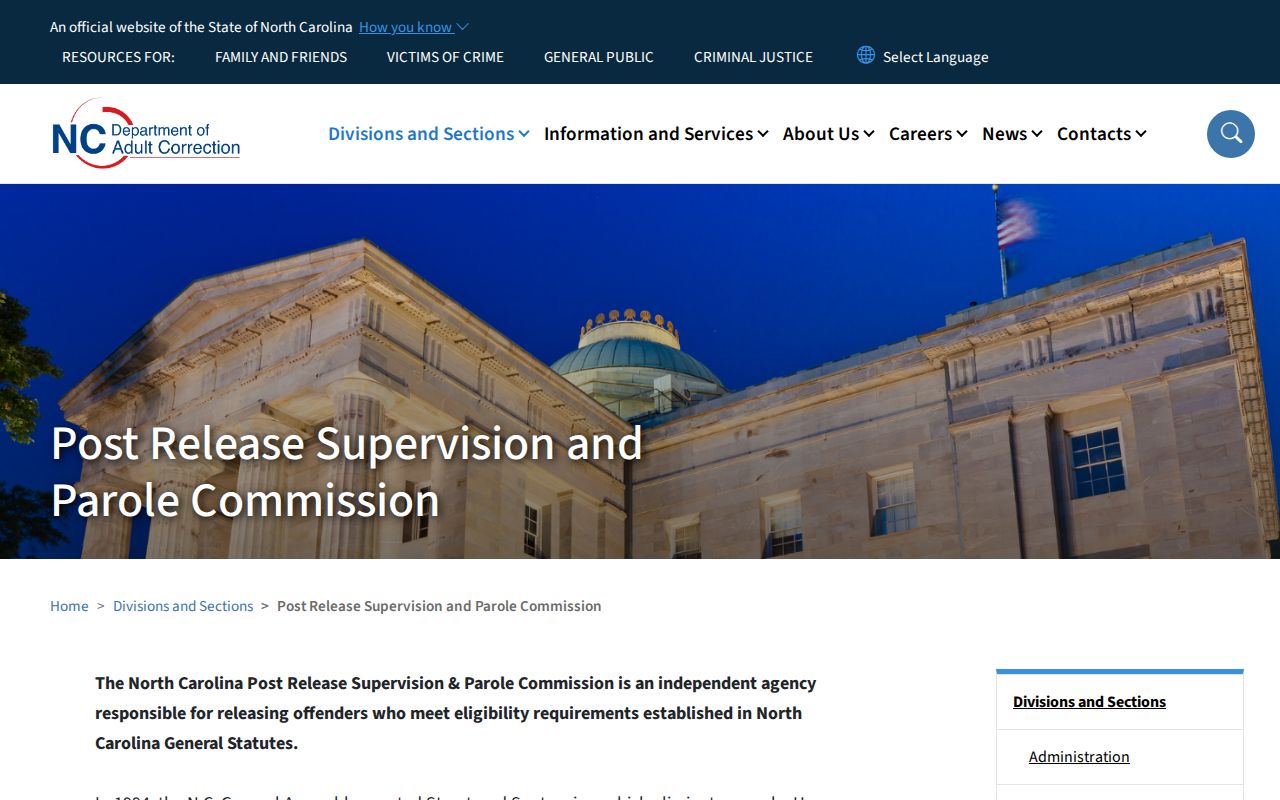
The screenshot should be read as an agency reference, not as proof that a named person was granted parole or released.
Catawba Reentry Before Final Release
Catawba Correctional Center is a minimum-custody state prison and reentry facility. DAC describes transitional programs and work-release participation there. Work release remains custody. A participant may work outside under program rules while still serving a sentence, so the program must never be relabeled as community discharge.
When final prison release occurs, confirm it in DAC history and then read any active supervision entry. A transfer from Catawba Correctional Center to another prison is still state custody. A move to PRS means the person left prison but remains under DAC Community Supervision. These distinctions make the local reentry role useful context without turning a facility program into release proof.
When Catawba Supervision Ends
Supervision ends through an official termination or discharge, not merely because a projected date passed or a person no longer appears in one view. Check the OPI record for termination language and keep the exact date and label. If formal proof is needed for a court or personal record, request the public termination data from DAC. The broader Catawba County released inmate search explains how to reconcile jail departure, state release history, and court disposition.
Completion can also affect the timing of an expunction petition. The North Carolina Judicial Branch explains that some waiting periods run through completion of the entire sentence, including probation, post-release supervision, or parole. A prison release date is therefore not always the date from which a waiting period runs. The filed judgment, DAC termination entry, and any Commission discharge should be kept as separate records. Eligibility remains specific to the disposition and governing statute.
DAC Victim Support describes notices for supervision events that may include a hearing date and location, final disposition, absconding or capture, and termination or discharge. These messages track a different stage than an initial jail custody alert. Save the reporting agency, event wording, and date, then compare the notice with the current OPI entry. A notification can lag and should not replace an official termination record.
A result can change after a violation, correction, or new custody event. Save the offender number and record date, then confirm with the creating agency. That approach separates a past release, active supervision, later reconfinement, and final discharge without guessing.