
Federal System Release Paths
The Federal Bureau of Prisons, usually shortened to BOP, holds people serving federal prison sentences. A release from BOP may mean sentence completion, transition to federal supervised release, placement outside a secure prison under another authorized status, or departure from BOP responsibility. The locator’s wording identifies BOP status only. It does not certify that no state, local, immigration, or other federal authority holds the person.
No BOP institution was found in Catawba County. A local connection may arise because the person lived in the county, had a federal case connected with the area, or spent time at the Catawba County Detention Facility under a federal agency line. Local holding does not make the county jail a federal prison, and departure from that jail does not by itself establish a BOP release.
Federal pretrial custody belongs to a different path. The U.S. Marshals Service manages many people awaiting federal proceedings and arranges detention through local or contract facilities. If the person has not been committed to BOP, the federal docket, counsel, and appropriate USMS public channel are more useful than the prison locator.
Search Federal Release Records
The official BOP Inmate Locator covers federal inmates from 1982 onward. Older records can also be searched by register number or name through the options the agency provides. Start with a federal identifier when available because it separates same-name results more reliably than biographical details alone.
- Select an identifier search if you have a BOP register, DCDC, FBI, or INS number. A BOP register number follows the pattern of five digits, a hyphen, and three digits.
- If no number is known, enter first, middle, and last name. Use the optional race, age, and sex fields only to distinguish likely matches.
- Compare the returned name, register number, age, race, and sex. Do not select a person based only on a shared name.
- Read the location or status and release date exactly as displayed. Save the register number for later checks and records requests.
- Recheck the result if timing matters, then use BOP FOIA or the federal docket when a durable record or fuller explanation is required.
The official locator image below comes from the Federal Bureau of Prisons search captured for this Catawba County release resource.
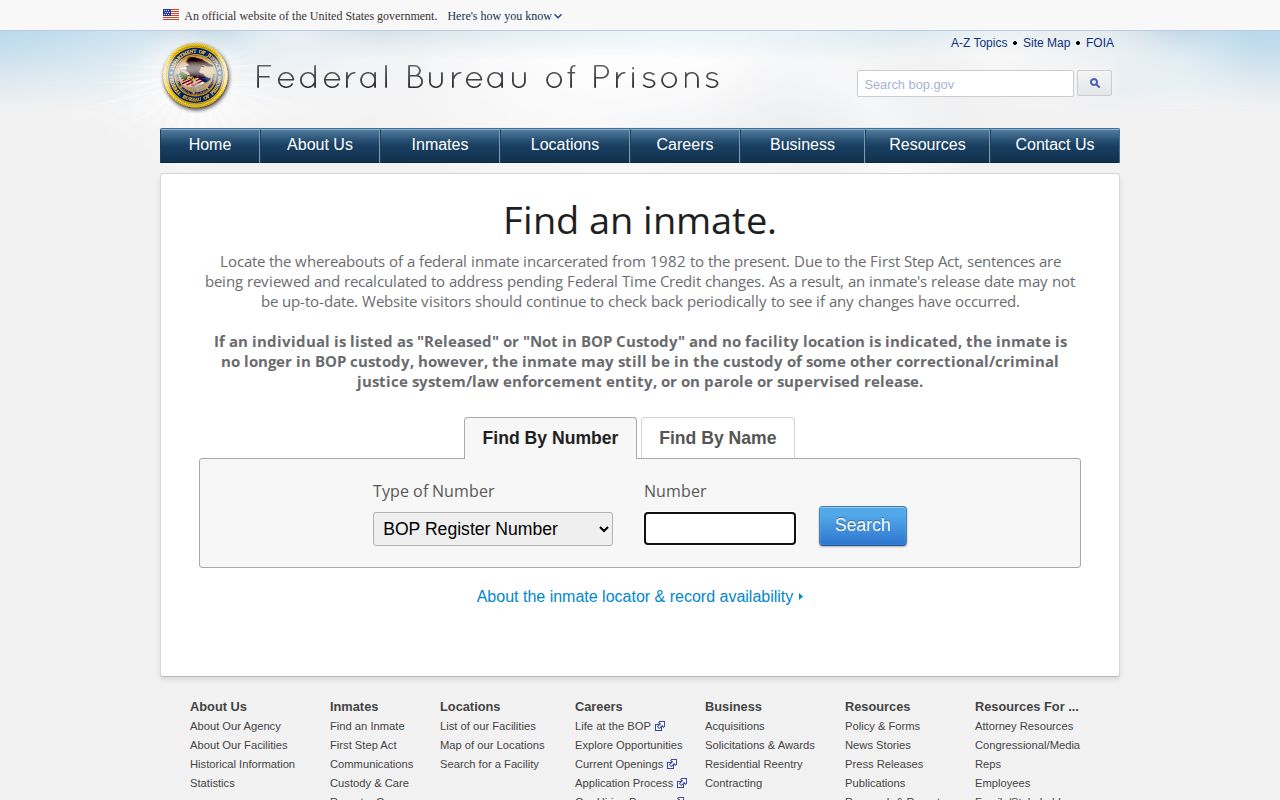
The form separates identifier and name searches, which is why a register number should be preserved whenever a matching federal record is found.
Interpret Federal Release Status
A result may display “Released” or “Not in BOP Custody.” Those phrases should be quoted accurately. “Not in BOP Custody” means that BOP does not currently hold the person. It does not establish unrestricted freedom, final sentence discharge, or absence from another correctional or law-enforcement system.
The result may show name, register number, age, race, sex, release date, and a location or status entry. A release date is evidence of the BOP event, but it should be matched to the correct identity and checked against the federal case when the legal outcome matters. A person may continue under federal supervised release after leaving prison. That community status is not the same as being confined by BOP.
A BOP status answers who holds the person now, not every custody or supervision question that may follow the federal prison event.
Dates can also be recalculated. BOP notes that First Step Act calculations and other record updates can affect displayed information. For that reason, a saved result is useful history but a current result should be checked again before relying on timing.
Federal Release Records and Contact
The locator is the public first step, while BOP’s Freedom of Information Act route is the records channel for a certified or more detailed federal prison history. Identify the person by full name and register number when known. Describe the specific admission, location, movement, or release record sought rather than asking for an undefined complete file.
Federal Bureau of Prisons
Locator: BOP Inmate Locator
Records: BOP Freedom of Information Act
Coverage: federal inmates from 1982 onward, with older records searchable through offered name or number routes.
Catawba County Local Custody Record
Catawba County Sheriff’s Office100 Government Drive, Building E
Newton, NC 28658
Detention Facility: 828-465-8999
Records Division: 828-465-8300
Email: Records@CatawbaCountyNC.gov
Use Sheriff Records only for the local booking-and-release event. Ask for the receiving agency or destination if a Catawba departure was a federal transfer. Use BOP for the later federal prison record. The two agencies document different segments of custody.
Federal Custody Serving Catawba
The facility map identifies the Federal Bureau of Prisons as a system page because there is no BOP prison located in Catawba County. This distinction prevents an address or local roster from being invented for a federal institution that does not exist in the county. It also keeps the BOP locator in its proper role as a nationwide federal prison tool.
A person convicted in federal court may never appear in the Catawba jail. Another person may appear there briefly on a U.S. Marshals line before trial or during movement. A third may enter BOP only after sentencing and designation. These paths can share a federal case but produce records in different systems and at different times.
- BOP
- The federal agency that operates prisons and maintains the public inmate locator.
- USMS
- The U.S. Marshals Service, which manages many federal pretrial detainees and prisoner movements.
- Federal supervised release
- Court-ordered community supervision that can continue after federal imprisonment.
- Register number
- The stable BOP identifier used to distinguish a federal prisoner record.
USMS Has No Public Locator
The U.S. Marshals Service has no national public detainee locator comparable to BOP. Searching BOP for a federal defendant who is still awaiting trial can therefore return nothing even though the person remains in federal custody. The absence may simply mean the person has not entered BOP responsibility.
Use the federal docket and counsel to track the case stage and detention orders. PACER is the federal court records system. Filed orders can show detention, release conditions, sentencing, commitment, or later supervision matters. USMS prisoner operations materials explain the agency’s custodial role, but they do not expose a nationwide person search.
If a Catawba jail entry showed U.S. Marshals as the agency, ask Sheriff Records whether the person left for a receiving authority. Then match that event to the federal docket. Do not convert a local roster disappearance into a BOP release date.
Federal Holds After Catawba Release
Live Catawba records can include U.S. Marshals or other federal agency lines. That makes “released from Catawba” a description of one agency’s custody change, not a guarantee of community release. The person may be handed to USMS, moved to another contract jail, or transferred after a federal order.
The county release entry should be requested with both the timestamp and the “released to” destination. The receiving agency establishes the next search path. If USMS received the person before trial, use the docket and counsel. If BOP received the person after sentencing, allow for intake processing and then use the locator. If ICE received the person, the ICE detention and removal system page explains that separate locator.
A federal hold line is a bridge to the next authority. It is not the event itself. Preserving the agency label, court case number, local booking range, and federal identifier makes the later record easier to reconcile.
Build a Federal Release Record
Strong confirmation combines identity, custody, event, and legal records. Save the BOP register number and exact locator wording. Obtain the relevant federal docket order when the case status matters. Request BOP records when the locator does not supply enough detail. If there was a Catawba booking, request the county transfer or release entry separately.
| Source | What it can establish | Key limit |
|---|---|---|
| BOP locator | Federal prison identity, status or location, and displayed release date | Does not cover every federal pretrial detainee |
| BOP FOIA | Requested federal prison records subject to disclosure rules | Requires a focused request and processing |
| Federal docket | Detention, release, judgment, commitment, and supervision orders | An order may precede agency processing |
| Sheriff record | Catawba booking, departure time, and documented receiving agency | Does not certify the later federal outcome |
Use the most recent source for present status and retain older records as history. A genuine federal prison release event can remain historically true even if another authority later confines the person.